This blog is about the day that broke many myths around prison for me. This is my observation during my visit to the District Jail of Ghaziabad as an intern with India Vision Foundation became a defining point in my understanding of incarceration and human potential. It was the first time I had ever stepped inside a jail, and like many others, my mental image had been shaped by societal warnings, film portrayals, and cultural narratives that define prison solely through fear and condemnation. From childhood, phrases like “If you do something wrong, the police will put you in jail” build an early association between prison and horror. Popular cinema reinforces this further by painting inmates as men lost to crime, darkness, and irredeemable violence. I, too, believed that prisons existed only to punish, isolate, and diminish the human spirit.
Yet, the moment I stepped past the gates of the District Jail of Ghaziabad, I encountered a world far removed from my assumptions. What lay inside was not despair, but structure, creativity, dignity, and a steady movement toward self-reconstruction. Through the sustained efforts of India Vision Foundation, the jail had evolved into more than a correctional facility—it had transformed into an ecosystem of hope, engagement, and personal growth.
The first major stop on our visit was the art gallery where the training session was to be held. The gallery stood like a testament to the human capacity for reinvention. The walls were adorned with intricate embroidery, deeply expressive paintings, detailed fabric art, and finely crafted needlework. One of the inmates mentioned that the most exceptional pieces had already been sold, and what we were seeing were the remaining ones. Even those works, casually termed “leftovers,” carried artistic excellence that rivalled professional creations outside prison walls. It was impossible not to sense the discipline, patience, and emotional investment woven into every thread and brushstroke.
From the art gallery, we moved to the sewing unit where inmates were engaged in stitching school uniforms and other materials under the prison’s vocational initiative. Rows of individuals worked with careful coordination, professional neatness, and visible pride in their labour. What struck me further was learning that inmates associated with this unit could earn nearly ₹20,000 per year, an amount they viewed not in monetary terms alone, but as a symbol of capability, responsibility, and earned dignity.
Next, we visited Radio Parvaaz, powered in collaboration with HCL Foundation. The initiative held a rare emotional resonance. It was a community radio station operated by inmates for inmates, filling the daily silence of prison life with stories of inspiration, devotional music, calming hymns, educational capsules, and thoughtful reflections. The sound carried across barracks every morning and evening like an unseen companion offering solace and strength. To me, it felt like an intervention of sound-based healing—a form of emotional and mental balance delivered through voices, melodies, and meaning.
The post-training visit explored further rehabilitation spaces created in partnership with India Vision Foundation and other supporting institutions. The art and craft hall was a world of miniature ingenuity. Handmade ships, foam sculptures, festival décor, mountain models, and even a door structure crafted from basic materials for a Ramleela performance during Diwali demonstrated not just skill, but storytelling. There was visible emotional freedom expressed through creation, even within physical boundaries.
The computer training hall operated on peer learning—trained inmates teaching newcomers essential computer functions like word processing, spreadsheets, and digital documentation. This space represented forward motion, preparation, and the desire to re-enter society not as former offenders, but as capable individuals seeking reintegration, contribution, and respect.
One room held a unique energy—the dance and music therapy unit. I witnessed inmates teaching and learning from one another, singing devotional compositions, practicing rhythmic coordination, and performing in harmony with live instruments such as the harmonium, drums, and tabla. Their collective performance for us carried professional finesse, emotional release, and a reaffirmation of identity beyond their prison labels.
Among all the moments, one conversation stood immovable in my memory. An inmate who had spent more than ten years in the jail system shared with me:
“When I first came here, I sat alone for months in guilt. I felt dead from the inside. But India Vision Foundation brought me back to life. Today, I am someone I never imagined I could become.”
His words carried more than gratitude—they carried proof. Proof that transformation is not aspirational rhetoric. It is possible, measurable, and powerful when guided by belief and opportunity.
I walked out of this visit redefined. I no longer see prison as a tomb of regret. I see it as an uphill corridor of correction, progress, reflection, learning, and rebirth. The essence of rehabilitation lies not in excusing crime, but in transforming the self that committed it. This is where the mission of India Vision Foundation becomes vital—planting opportunity where it is assumed barren, rebuilding potential where it is declared abandoned, and believing in human evolution even inside a locked gate.
As Dr Kiran Bedi Ma’am says, “Life is always on an incline—you either go up or you go down.” This inclination exists even inside prisons. My visit taught me that people can choose to rise when institutions stand beside them, believing that a second chance is not a privilege, but a possibility.
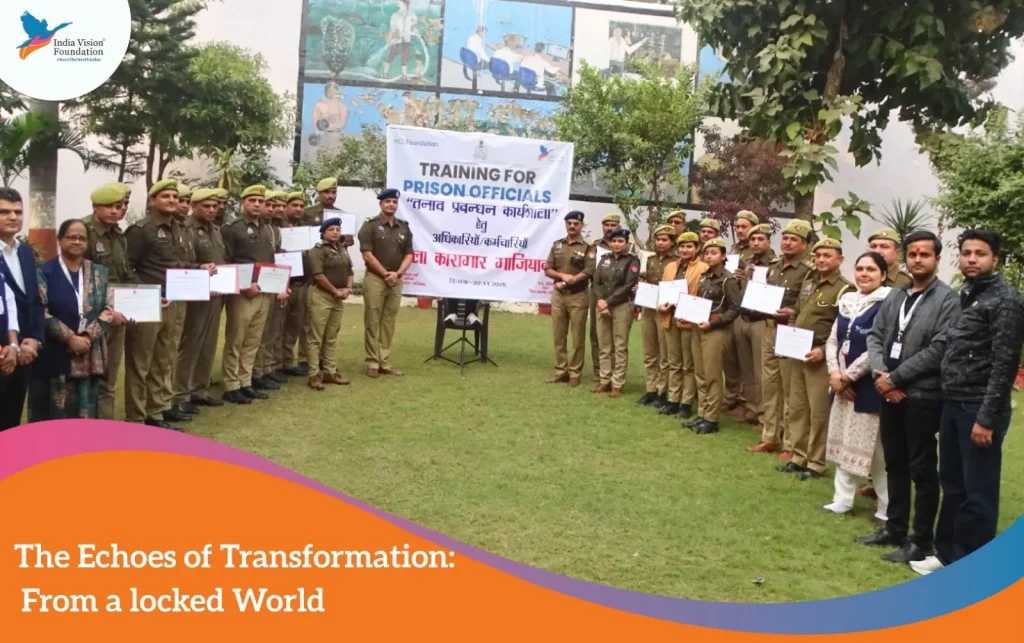
The training programme led by Vikas Khurana was attended by 46 prison officers and added another dimension to this journey of understanding. The session began with the question, “Is stress necessary?” An officer responded that stress keeps them punctual and alert. From here, Mr Khurana clearly distinguished pressure and stress—pressure arises from external demands, while stress is an internal reaction to the same. Officers related closely when he explained the emotional and mental challenges of working in an unpredictable custodial environment.
He introduced grounding techniques, mid-shift breathing resets, mindfulness-based relaxation, and short practical exercises to mentally recalibrate during duty hours. The officers participated enthusiastically, shared personal experiences, and practiced the techniques in real time. By the end of the session, the room felt visibly lighter, the body language softer, and the voices calmer. Many officers expressed that they felt not just instructed, but heard, understood, and supported. The session empowered them with tools usable both in their professional and personal lives, making the initiative deeply purposeful.
I left the prison not only inspired by inmates reclaiming themselves, but by officers seeking balance, unity, and emotional strength to serve their duties better. This dual transformation reaffirmed a central realization: rehabilitation is not limited to inmates—it extends to every individual within the prison ecosystem when the environment enables healing, learning, hope, participation, and dignity.
About the author
Anand is currently continuing his one-month internship at India Vision Foundation. Pursuing his law degree from Symbiosis Law School, Nagpur, Batch of 2025-2030, he has gained meaningful exposure working with international bodies and institutions focused on global youth and policy initiatives. His work combines research, leadership, and community engagement, with a strong interest in socio-legal issues and sustainable development. He continues to explore opportunities that deepen his understanding of law in global and national contexts.