By: Hussain Zaidi
Senior Project Coordinator,
Rehabilitation & Reintegration Program,
India Vision Foundation
The recent visit of the Hon’ble Chief Justice of India Mr. Surya Kant to District Prison
Gurugram, and his call to reimagine prisons as correction homes, resonated deeply with me—
not as an abstract reform idea, but as a lived reality I have witnessed over the past three years
while working with India Vision Foundation.
When the CJI emphasized that “through skill development, prisoners can become assets after
release,” he articulated what many of us working inside prisons already know: incarceration
does not erase human potential. It merely obscures it—until someone chooses to see beyond
the prison walls.
Seeing the Person Before the Prisoner
In my work with India Vision Foundation, I have met hundreds of inmates and released
individuals—men and women carrying not just the weight of a sentence, but also of poverty,
broken family structures, lack of education, trauma, and stigma. Very few entered prison with
criminal intent as a defining identity. Most entered because of circumstances—lack of
opportunity, survival decisions, or systemic neglect.
The CJI’s observation that justice must move beyond punishment toward renewal mirrors what
we practice daily. Though Foundation’s Inside prisons 4S Model (Shiksha, Sanskar, Swasthya
and Skill), we have seen how access to education, skill training, counseling, and dignity can
reawaken self-belief. A man who learns computer skills in custody. A woman who stitches not
just fabric, but confidence. A young inmate who speaks on prison radio for the first time and
realizes his voice matters.
These are not exceptions—they are outcomes of intent
Reintegration Is Not an Event, It Is a Process
One of the most critical points highlighted during the CJI’s address was reintegration after
release. From experience, I can say this is where the real test begins.
Release does not mean freedom—it often means isolation. Families are strained, livelihoods
are uncertain, and stigma follows relentlessly. At India Vision Foundation, our rehabilitation
and reintegration program work continues after the prison gate opens: continuous tele callings,
regular home visits, need assessments, livelihood linkage, self-employment support under
Project Saakaar, telephonic follow-ups, and emotional counseling.
Without this continuum of care, many individuals risk falling back into cycles of
marginalization. Reintegration must be planned, supported, and humane—not left to chance.
Correction, Not Containment
Renaming prisons as correction homes is not merely symbolic—it demands a mindset shift. A
correction home must correct systems, not just individuals. It must acknowledge that
rehabilitation requires collaboration between prison administration, civil society, employers,
families, and communities.
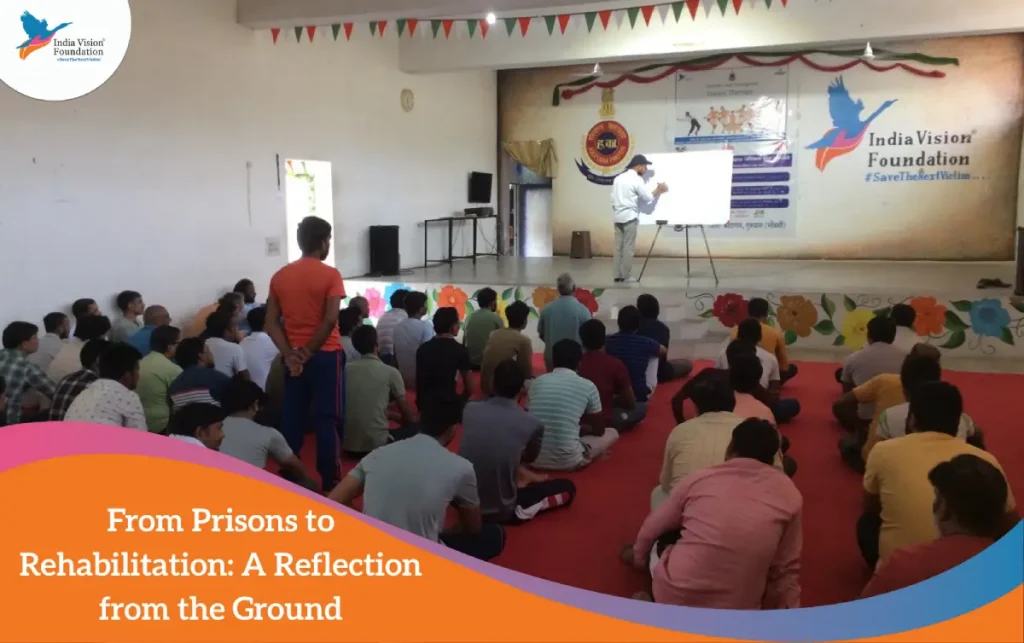
In Gurugram and across NCR prisons, we have seen encouraging openness from prison
authorities to such partnerships. Programs like readiness-to-release sessions, prison radio,
vocational training, and post-release support demonstrate that correctional justice is achievable
when intent meets action
Why This Moment Matters
The CJI’s visit validates years of grassroots rehabilitation work carried out quietly by prison
staff and organizations like India Vision Foundation. It signals that reformative justice is no
longer on the margins of policy—it is entering the mainstream discourse.
For practitioners like me, this is both affirmation and responsibility. Affirmation that our work
matters. Responsibility to deepen it, scale it, and ensure that no released individual is left
behind due to stigma or systemic gaps.
Looking Ahead
If prisons are to become true correction homes, then success must be measured not by
incarceration rates, but by reintegration outcomes—employment secured, families reunited,
dignity restored, and cycles of crime broken.
Having walked alongside beneficiaries before, during, and after incarceration, I firmly believe
that when we invest in human potential, society gains citizens—not liabilities.
The CJI’s words remind us of something simple yet profound: justice is not complete until
hope is restored