The global prison system stands at a critical crossroads.
Across the world, more than 11.5 million people are incarcerated. Yet the impact of imprisonment does not remain confined within prison walls. It extends deeply into families, children, communities, and future generations. Increasingly, global conversations on justice are recognising that incarceration alone does not create safer societies. In many cases, it reinforces cycles of exclusion, stigma, poverty, and disadvantage.
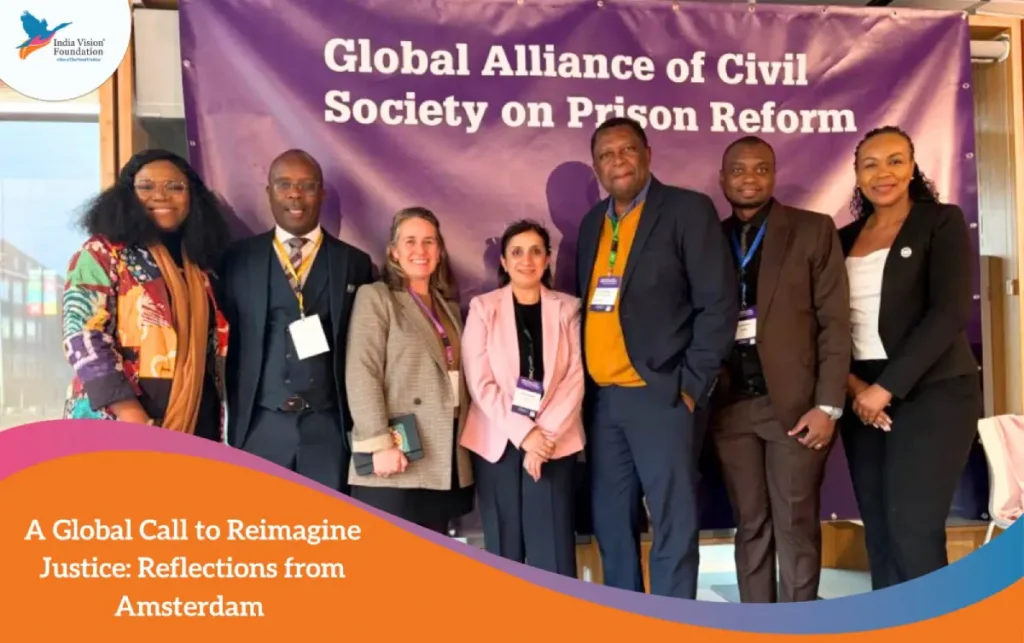
It was in this context that civil society organisations, practitioners, researchers, and leaders with lived experience came together in Amsterdam for the Global Alliance of Civil Society on Prison Reform Kick-off Conference, convened by Penal Reform International on 26–27 March 2026.
The conference brought together 45 participants from 31 countries, creating a meaningful global platform to reflect on prison reform, rehabilitation, reintegration, human dignity, and community-based approaches to justice. For India Vision Foundation, participation in this global convening was both a learning opportunity and a moment of strategic visibility.
A key outcome of the conference was the adoption of the Amsterdam Declaration, a collective commitment by civil society organisations to reimagine justice systems through dignity, human rights, accountability, and the meaningful inclusion of lived experience.
The Declaration recognises that the over-reliance on imprisonment does not necessarily make societies safer. Instead, it often deepens existing inequalities and leaves families and communities to carry the long-term consequences. It calls for reducing dependence on incarceration, strengthening safeguards and accountability, addressing stigma and discrimination, and ensuring that people with lived experience are not merely heard, but meaningfully included in reform efforts.
One of the strongest messages from Amsterdam was clear: prison reform cannot be viewed as an isolated issue. It is connected to social justice, child protection, mental health, livelihood, reintegration, family resilience, and community support.
For India Vision Foundation, this message deeply resonated with our own journey.
At the conference, India Vision Foundation was proud to be featured in the Innovation Session, where our work with children of incarcerated parents and vulnerable families was presented as a critical intervention to break intergenerational cycles of disadvantage. This recognition reaffirmed a belief that has guided our work for decades: prison reform must extend beyond prison walls.
When a parent is incarcerated, the child often carries an invisible sentence — one marked by disruption, stigma, emotional distress, educational risk, and social exclusion. Supporting these children is not charity; it is prevention, protection, and justice in its most human form.
Our work with children and families affected by incarceration is rooted in the understanding that rehabilitation must include the family ecosystem. A person’s journey towards reintegration is deeply shaped by whether their children are supported, whether their family is stabilised, whether stigma is addressed, and whether the community is prepared to receive them with dignity.
Across the conference, organisations from different regions shared similar concerns. Systems that rely heavily on punishment often fail to address the root causes of crime, vulnerability, and exclusion. Families are pushed further into hardship, children grow up carrying stigma, and individuals released from prison continue to face barriers in rebuilding their lives.
This is not only a criminal justice concern. It is a social and developmental challenge.
India Vision Foundation’s approach has consistently focused on these deeper and often invisible impacts of incarceration. Through our programmes, we work to support children and families, enable education and psychosocial wellbeing, create rehabilitation and skill-building opportunities, strengthen reintegration pathways, and build community-based support systems.
The conversations in Amsterdam also reinforced the importance of lived-experience leadership. Reform cannot be designed only for people; it must be shaped with them. The voices of women who have experienced incarceration, released beneficiaries, young people from affected families, and communities closest to the issue must become central to programme design, advocacy, training, and policy conversations.
Another important theme was the shrinking space for civil society across many parts of the world. Participants shared concerns around restrictions on advocacy, prison access, funding independence, and public discourse. In this context, the formation of a global alliance becomes even more important. It allows organisations to learn from one another, stand in solidarity, share evidence, and build collective strength.
For India Vision Foundation, the conference opened meaningful pathways for partnership and knowledge exchange. Organisations working on women’s reintegration, lived-experience leadership, rehabilitation, prison reform, storytelling, and global visibility offer valuable opportunities for future collaboration.
The strongest takeaway from Amsterdam was that India Vision Foundation’s prison-to-community approach is not only relevant in the Indian context, but also deeply aligned with the emerging global movement on justice reform.
The future of prison reform must be humane, inclusive, and rooted in dignity. It must recognise that every person has the capacity for change, every family deserves support, and every child deserves a future free from inherited stigma.
The Amsterdam Declaration marks the beginning of a stronger and more connected global movement. For India Vision Foundation, it is both a recognition and a responsibility.
We remain committed to expanding our work with children and families affected by incarceration, strengthening lived-experience participation, building meaningful global partnerships, and contributing to a more humane vision of justice.
Because justice must restore, not just punish.
Real change lies not only in reforming systems, but in restoring lives, rebuilding families, and creating second chances. That is the future we are working towards